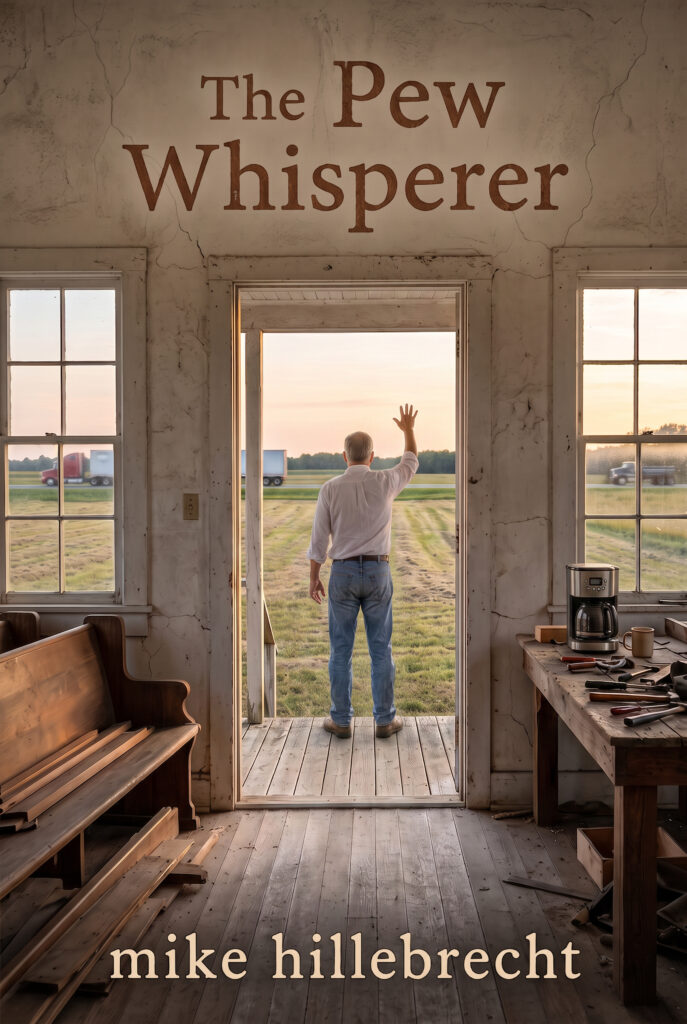
THE PEW WHISPERER
A novel by mike hillebrecht
Wes Conrad, a defrocked minister in his late fifties, wanders the rural West restoring abandoned churches — a task he never lets himself finish being finished with. Years earlier, an affair ended his marriage; in the strained months afterward, while he and his wife Grace were still trying to rebuild it, a car accident killed her. Wes was driving. Her last words to him — an unplanned, unrehearsed realization that his years of trying to earn his way back into her love had never been necessary in the first place — were cut off mid-sentence by the crash, along with his own reply. He has never told anyone what he said, or meant to say.
Tate Wyecomb, a ranch hand in his mid-thirties, breaks down outside Wes’s current restoration project on a Thursday afternoon. A four-day wait for a truck part becomes five once the weekend intervenes, and Wes takes him in. Tate was raised on a theology of earned grace — confession before restoration — and has never fully escaped it, even though it already cost him everything once: years earlier, he caught his addicted younger brother, Cody, stealing a family heirloom pocket watch to fund his habit, and gave him an ultimatum instead of help. Cody died a month later, before either side of that bargain was met.
Over the five days, the two men’s different grammars of grief press against each other. Wes recites Alan Watts by firelight and drinks bourbon he doesn’t hide; Tate watches, unsettled, until an argument about confession and forgiveness draws an involuntary fragment out of Wes — “I said yes” — the first crack in a wound Tate doesn’t yet understand. A supply run reveals a second finished church, Colby, proof Wes can complete what he starts; it also triggers a flashback to Kessler, the one church he fled unfinished, after discovering a stranger’s headstone bearing his late wife’s name and matching age. On Sunday, Wes’s weekly ritual — waving at passing trucks from the church steps, weeping openly and unashamed — finally provokes Tate to ask what any of it means, and Wes tells him everything: the affair, the accident, Grace’s unfinished sentence in the car. Tate, in turn, tells him about Cody, the watch, and the ultimatum he has spent thirteen years unable to either defend or fully renounce.
On Monday, as Tate prepares to leave, Wes is blindsided by unrelated news: the church he fled at Kessler, broken and abandoned for two years, has quietly filled with a congregation and come back to life without him. It directly contradicts the story he has told himself about what he does to the things he loves. Denny, the mechanic, has already quietly paid for Tate’s part; when Tate tries to settle the bill anyway, both Wes and Denny refuse any further payment, leaving Tate holding a debt with nowhere to put it — the first real crack in his own lifelong instinct to keep score.
Tate drives away changed but not resolved — still grieving Cody, still uncertain what his ultimatum meant, but visibly loosening his grip on the ledger he has always kept. Wes, alone again, opens a third box of private keepsakes and reads unmailed letters to Ivy, his estranged adult daughter, who cut him off after the affair and has never forgiven him for the accident. That wound stays exactly as open as it has always been. The following Saturday, drawn back to Kessler out of curiosity, Wes has a brief, unremarkable encounter outside the thriving church with a stranger named Leon Scheffield — neither man recognizing anything significant in the other — before driving home.
The novel ends without resolving any of its central wounds. Tate’s watch, once hidden, is wound openly in front of Wes for the first time before he leaves — recognition, not closure. Wes’s Sunday ritual continues exactly as it always has, its outward shape unchanged, its private weight now understood only by the reader. Ruth, the landowner who has quietly suspected all along that Wes was the one who left Kessler unfinished, decides — in the book’s closing pages — that some things are better known than said, and lets the question rest.