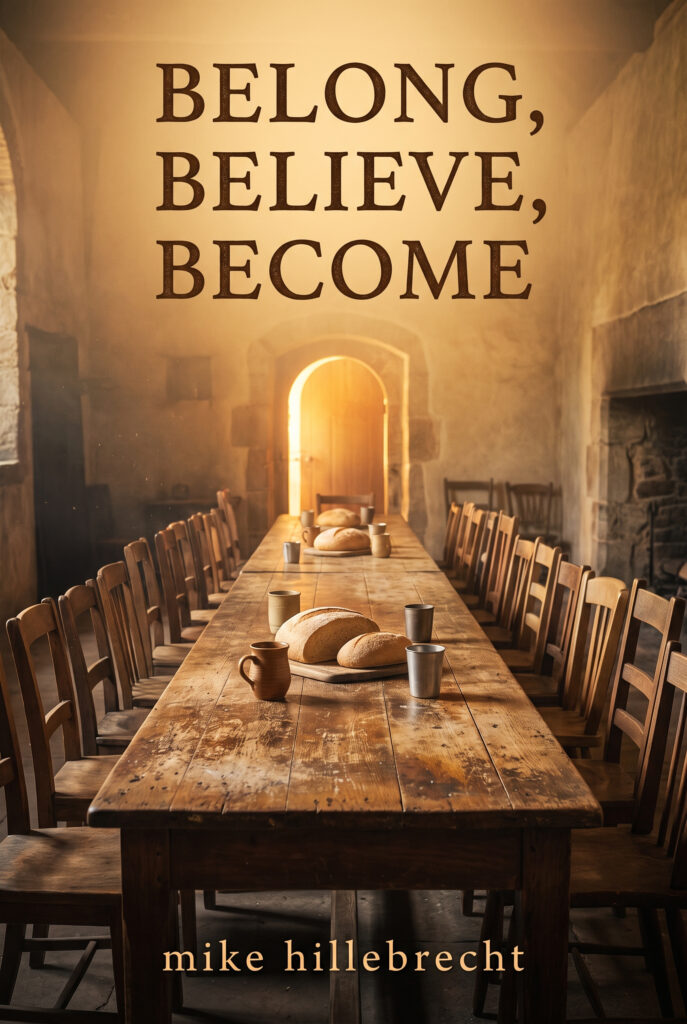
Belong, Believe, Become
Belong, Believe, Become is a short work of nonfiction theology built around a single claim: grace is not God’s response to human failure but the ground creation stood on before the fall, and belonging — not belief, not behavior — is where an honest spiritual life has to start. The book unfolds the claim in four movements, each answering the objection the previous one leaves standing.
Movement One, Belong, opens with the book’s central line — “before you were born, you were held” — and spends four chapters taking apart the courtroom model most readers inherited: sin as a legal debt, the cross as its payment, grace as the verdict that follows. Drawing on the Hebrew chesed and Paul’s language of grace existing “before the beginning of time,” the movement argues the courtroom was never the right room to begin with, and closes by naming everything belonging has been wrongly made to require — belief, moral cleanup, the right vocabulary — that it never actually needed.
Movement Two, Believe, takes up the question Movement One leaves open: if belonging isn’t earned through belief, what is belief actually for? It reframes belief as trust rather than proof — something leaned on rather than something certified — and gives doubt room to be part of that trust rather than its enemy. The movement’s hardest chapter engages Paul’s own legal-sounding language in Romans directly, offering an alternative reading through covenant faithfulness, the mercy seat, and reconciliation rather than acquittal, while explicitly acknowledging the traditional forensic reading remains a live, defensible position. It closes by giving belief permission to arrive slowly and unevenly, without a dramatic conversion moment.
Movement Three, Become, answers the objection that has been building since page one: if none of this is earned, does anything a person does actually matter? It does — the movement locates the real work not in behavior management but in uprooting covetousness, read as the generative root beneath the other nine commandments and the refusal to trust that what one already has is enough. It distinguishes real transformation from willpower-driven performance, reframes setbacks and long plateaus as ordinary features of slow, nonlinear change rather than proof of failure, and closes with the book’s most direct answer to the “cheap grace” charge: removing the fear of punishment removes the incentive to lie about real harm, making honest amends more possible, not less necessary.
Movement Four, Community, closes the book by insisting none of the first three movements can be sustained by a single person alone. It reframes the five ministry functions of Ephesians 4 as mutual interdependence rather than hierarchy, paints a picture of what a grace-shaped gathering, small group, and leadership meeting could look like, and then undercuts its own optimism deliberately with a chapter of anonymized, composite failure stories drawn from real patterns in church planting — founder burnout, financial opacity, doctrinal drift, recruitment by vague pitch, funding relationships that quietly sour. Each failure is matched to a concrete structural safeguard — term limits, financial oversight, a named process for raising harm — and the movement closes with a first-year implementation calendar before returning, in its final chapter, to the book’s opening line and asking whether it still lands the same way.
The book ends where it began, with the reader invited — not required — to walk through a door that, it argues, was never actually locked.