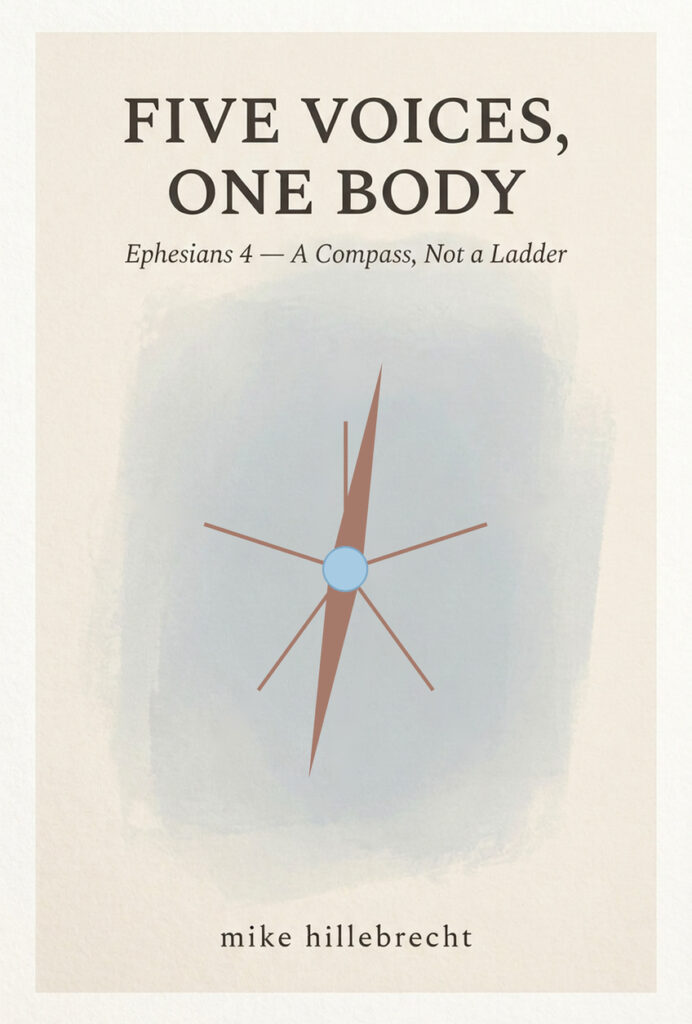
FIVE VOICES, ONE BODY
Ephesians 4 — A Compass, Not a Ladder
by mike hillebrecht
The word “fivefold” does not appear in any translation of the Bible. Ephesians 4:11 names five voices — apostle, prophet, evangelist, pastor, teacher — in a single sentence, with no ranking attached. Five Voices, One Body asks a question most readers have never been invited to ask: if Scripture never ranked these five, why does nearly every tradition that inherited them treat them as a ladder?
The book answers that question by following a deliberate four-part method rather than a conventional argument. Part One names the wound before offering any comfort: a “merit-based ministry” that measures apostles by how far they travel, prophets by the accuracy of their words, evangelists by conversion counts, pastors by retention, and teachers by completed curricula — a private ledger nearly every reader recognizes in themselves once it is named. Part Two returns to Ephesians 4:1–16 itself, reading it plainly and in order, without the filter any tradition has since layered on top of it. The passage opens not with offices but with oneness — “one body, one Spirit, one hope, one Lord, one faith, one baptism” — and only then names the five, equips the saints, and ends with “every joint” supplying what it was given to supply, with no voice singled out as the source of the body’s growth.
Part Three is where the book’s theological center arrives: the claim that grace was not activated at the cross but “given us in Christ Jesus before the ages began” (2 Timothy 1:9), which means the five voices were never the source of what they equip people to receive — only witnesses to a grace already there. Each of five chapters walks one movement of the passage (equipping, building, maturing, speaking truth in love, every part working), paired with a concrete scene showing what that movement looks like lived out, and a contrasting scene showing what a merit-based substitute looks like instead. A key move in this section answers a question readers who have never identified with any of the five offices have likely asked silently for years: Romans 12’s list of ordinary gifts — giving, mercy, exhortation — is not a lesser, separate category. It is read as the concrete content of Ephesians 4:16’s “every joint,” meaning a reader with no office at all is not standing outside the book’s argument. They are its actual point.
Part Four declines to resolve into a program. The book states plainly what it is not — a governance manual, a scholarly treatise, a verdict on any tradition or movement — and closes with questions rather than instructions, including the author’s own answer, offered first, to the question it asks the reader to sit with. A closing scene depicts a single, ordinary Sunday in which five unnamed figures and one unnamed teenager each supply what they were given to supply, with no voice credited above the others, and the explicit acknowledgment that the scene “cannot happen without you.”
Written for readers wounded by performance-based religious systems rather than for scholars or church leaders seeking a governance model, Five Voices, One Body is a short, exegetically grounded, pastorally direct argument against ranking what Scripture never ranked — and an invitation to stand on a grace that was never waiting to be earned.