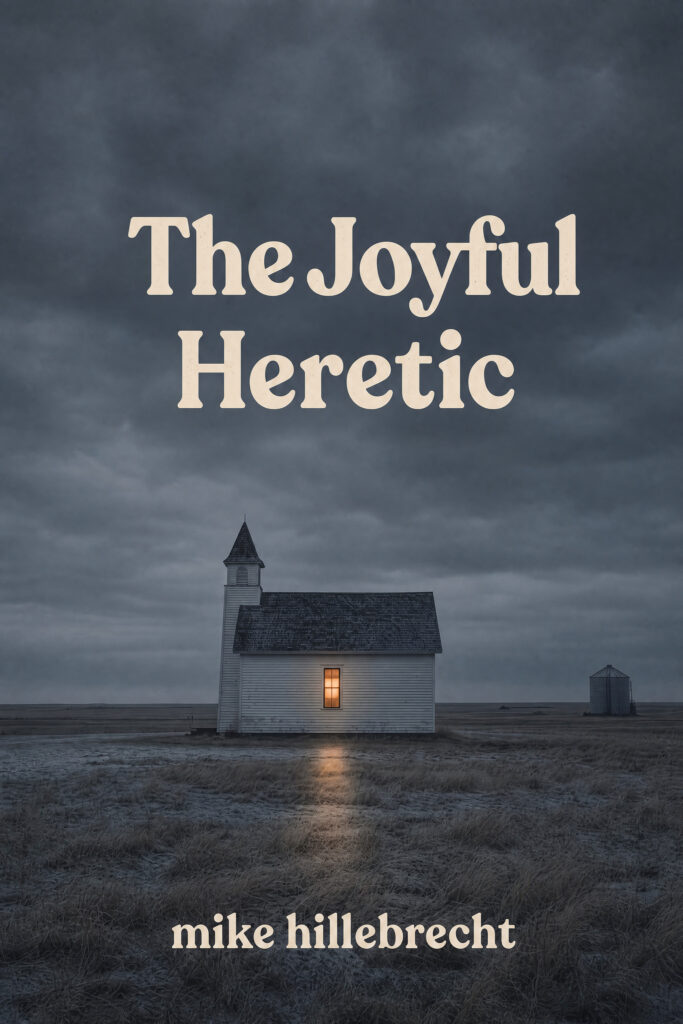
THE JOYFUL HERETIC
mike hillebrecht
Pastor Ruthanne Steiger has spent fourteen years preaching certainty over open graves while privately carrying the one grave she cannot stop returning to: Britta, a fourteen-year-old from her confirmation class who died by suicide after Ruthanne answered one of her questions about God with precise, faithful, and — Ruthanne has always secretly feared — too-small theology.
A letter arrives on a Tuesday from her dying mentor, Professor Vanthorpe. He is summoning his old seminar — Ruthanne, Dariusz, Torsten Brekke, and others — for one final week at his table. He doesn’t want to teach them a method this time; he wants to show them where thirty years of following the biblical text past tradition has led him, before he dies with the conclusions still in the drawer.
At the seminar, Vanthorpe lays out a scholarly case that the Greek word aiōnios — translated “eternal” for a thousand years — actually carries a bounded, age-long sense in its earlier usage, and that the church’s doctrine of endless hell may rest on a translation choice rather than a textual necessity. The revelation detonates differently in each student. Torsten, a pastor from Sioux Falls, collides with an anonymous woman in the group who has buried parishioners under the very doctrine now in question — was she lying to them, or telling them something true but too small? Dariusz, quietly devastated, reveals he reached the same conclusion long ago and has been carrying it alone.
Midweek, Margit Thorvaldsen-Kessler — a formidable elder from Ruthanne’s own congregation — arrives, revealed as an eleven-year secret correspondent of Vanthorpe’s. Margit’s question is not academic: she buried her husband, Henrik, under Ruthanne’s own graveside words, and she wants to know whether the ground she buried him in was real. The chapters that follow reveal a second, harder thread: Margit’s estranged daughter, Ingrid, left the faith and the family over this exact doctrine, and a letter from Ingrid — quoting a sentence Ruthanne herself once preached — is read aloud at the table.
At the seminar’s climax, Ruthanne breaks fourteen years of silence and names Britta aloud for the first time, in front of the group and in front of Margit. She refuses to hand anyone a comforting conclusion. Instead she offers a distinction: the theology she preached was incomplete, not false — a church that lies to the grieving has done one thing, and a church that told the truest thing it could see, but couldn’t yet see far enough, has done another. She leaves the question open rather than resolved.
Vanthorpe dies shortly after the seminar ends. Ruthanne returns home changed but not settled, and has to decide whether to bring what she’s learned back to her own congregation — including Margit, who is still deciding whether what Ruthanne has offered her is bread or a stone. The decision becomes public at a tense congregational meeting, where Henrik Solberg leads resistance to any reopening of settled doctrine and the Lindqvist family ultimately leaves the church over it. Margit, for her part, begins — tentatively, without resolution — to consider that the gap she has lived in for eleven years might be filled with something other than silence.
In the novel’s final movement, Ruthanne visits both graves she has spent fourteen years failing to look at directly — Henrik’s and, at last, Britta’s, two hundred miles away. She arrives at no tidy theological resolution. What she reaches instead is the ability to hold what cannot be fixed without needing to explain it away, and to add a second line, in her own hand, beneath the index card that has hung on her wall for twenty-six years: the wreckage was survivable. The novel ends not on resolution but on enough — Ruthanne going up to bed with a loaf of bread rising under a towel in the dark, having done the part that was hers to do, and left the rest.