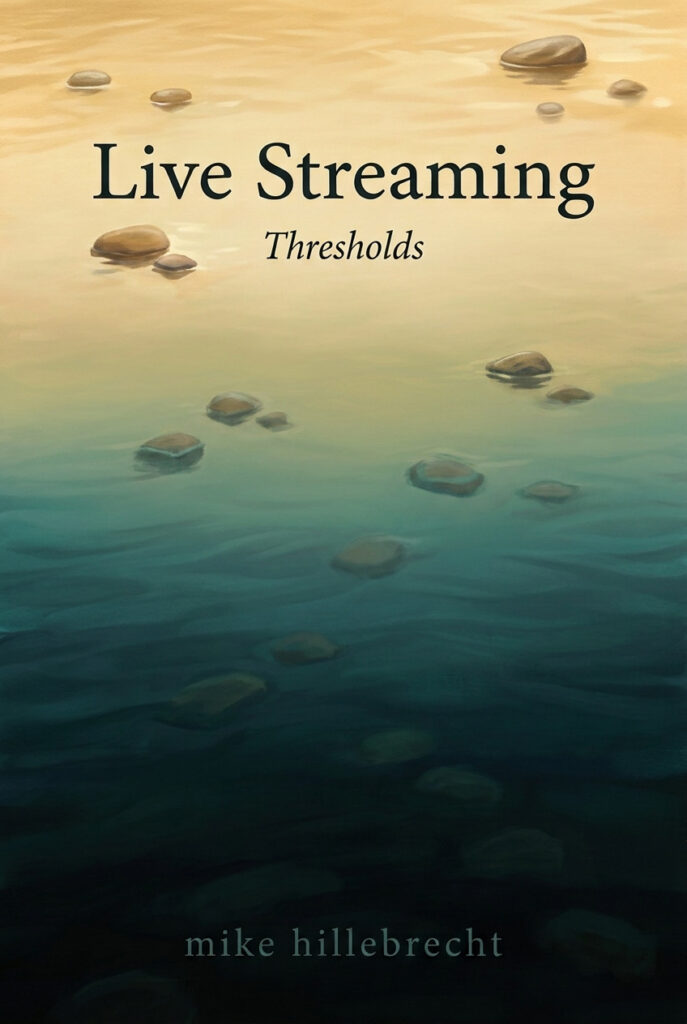
Live Streaming
Live Streaming is a collection of forty-eight short scenes, each dramatizing the same recognition arrived at from a completely different angle: that grace — or presence, or the ground of being, depending on which of nearly thirty spiritual traditions is speaking through a given scene — was never a destination anyone had to earn their way toward. It was already the condition they were standing in.
Rather than chapters, the book is organized into three depth-bands — Wading, Midstream, and Deep Water — that describe how far into the water a given hesitation sits, not a required reading order. A reader can open anywhere. Wading holds the beginner’s fears: that they’re not the type, that they’re fooling themselves, that they’ve already disqualified themselves through some past failure. Midstream holds the fatigue of people who’ve been at this a long time and have started to forget they’re still in the same river everyone else waded into — dryness, comparison, the hollow feeling of performing a role they once meant sincerely. Deep Water holds what’s hardest to stand on comfortably: unanswered prayer, real doubt, isolation, and, in its final and only wordless entry, a woman’s last afternoon.
No character in the book holds the whole truth alone. Insight is distributed across ordinary conversation — a laundry room, a diner booth, a car window rolled halfway down — and it survives being carried imperfectly. A citation gets misattributed. A name gets forgotten. A story arrives secondhand, garbled by a father’s retelling or a quote graphic shared without a source. The insight underneath is never diminished by the bad delivery. By the book’s midpoint this stops being an incidental texture and becomes the book’s own argument: recognition was never gated behind getting the citation right.
The scenes draw on real historical and religious figures — medieval mystics condemned by their own churches, a Sufi poet, a Zen master, a Hasidic rabbi who treated joy as a legitimate form of devotion, a Buddhist teacher who died peacefully surrounded by his community — but no figure is ever named inside the scene itself. A closing section, “What the Current Was Carrying,” identifies the real person or text behind each scene for any reader curious enough to go looking, along with an honest account of what’s documented history, what’s paraphrase, and what remains genuinely uncertain.
The book does not resolve neatly, on purpose. Several of its strongest scenes end in open ambiguity rather than comfort, on the conviction that real closure only happens once, at the actual end of a life — dramatized directly in the book’s final entry, the one scene written entirely without dialogue, following a woman through an ordinary afternoon in hospice. Elsewhere, the book is unexpectedly funny: a missing comma on a funeral cake sends a grieving family into unstoppable laughter; a wedding reception turns into something close to a religious service when a man commits fully to a terrible dance move. Grief and comedy are treated as the same order of truth throughout, never as relief from one another.
Written with particular attention to the millions of people who have quietly left institutional religious practice without leaving behind the hunger that practice used to hold for them, Live Streaming is ultimately a book about the difference between a citation and a recognition — and an argument, made forty-eight separate times, that only one of those was ever actually required.