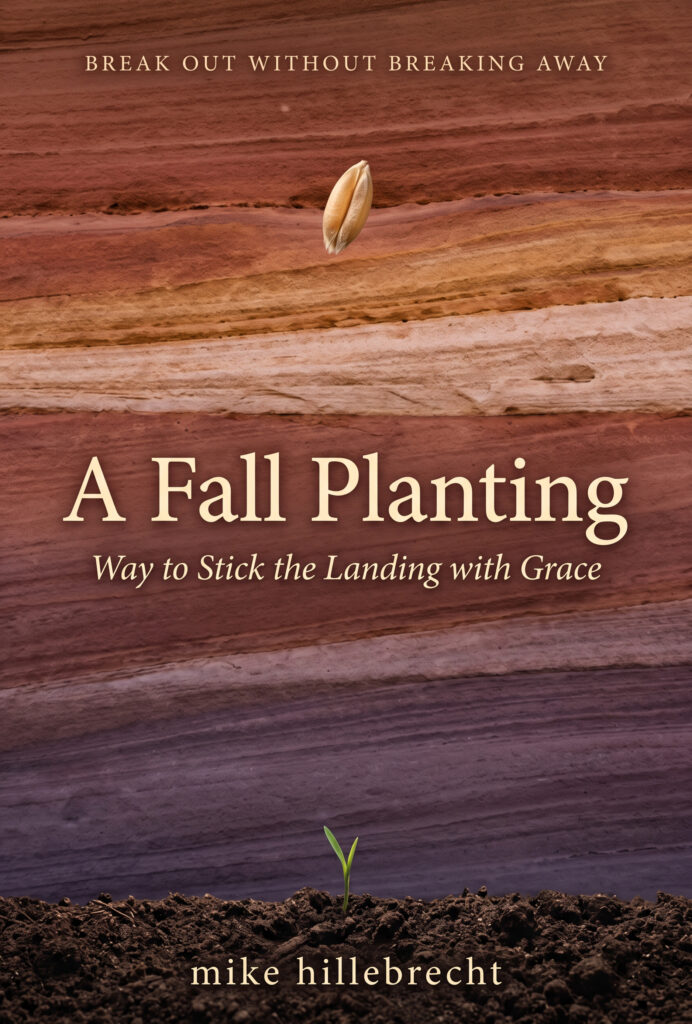
A Fall Planting
Way to Stick the Landing with Grace
mike hillebrecht
Pastoral nonfiction
The premise. Many believers sense that the relationship they were promised has become a structure to maintain, but the only exits they are shown are to stay and keep straining, or to leave and lose their people. A Fall Planting offers a third way: break out of the framework without breaking away from the people. Its foundation is that the reader was held, loved and prayed for before they ever reached for God, and that what feels like falling away is often a seed falling into the ground.
The spine. Every chapter is anchored in Jesus’ prayer in John 17, where he prays for everyone who would ever believe. The book opens with that prayer: you were overheard before you ever prayed. All Scripture is quoted from the King James Version.
Movement one: the canyon (Chapters 1–6)
The reader is pictured clinging by their fingernails to a canyon wall, having gone over the railing where the church taught them to admire God’s depths from a safe distance. Chapters name the warning that keeps people frozen (“this is a slippery slope”), the accusing voice behind it (“Who told thee that thou wast naked?”), and the ledges people settle on: trying harder, bitterness, indifference, shame and self-sufficiency. Some were pushed over the edge; others ran off it chasing a miracle. Either way, the movement ends at letting go, and at the discovery that the Father’s arms were underneath the whole time. Here the book names that love once, as chesed, in the father who runs to the returning son.
The turn: the grain falls (Chapter 7)
John 12:24 joins the two halves. The fall had a floor. What dies is the grip, not the person, and the floor turns out to be soil. Like Jacob waking on his stone pillow, the reader finds the ground was holy all along: “Surely the LORD is in this place; and I knew it not.”
Movement two: the vine (Chapters 8–13)
Now the reader learns to stand: the wobble of new sea legs, roots going down into love, and Jesus as the first one rooted rather than the inspector of the fruit. The kingdom is found within, and prayer starts in the closet. Fruit is something that grows, not something to be counted, and it has always been one fruit, not nine. Union never erases the person (“nothing is outside him, but that doesn’t mean everything is him”), and no one is “other.” The final chapter, Planted in the Pew, is practical: how to sit through sermons, songs, altar calls, offerings, small groups and warnings while staying rooted, with a closing word addressed to pastors.
The author’s thread
The argument is carried by the author’s own story, told plainly and without spiritual heroics. It begins in 1994, on a pastor’s couch with a newborn daughter in the hospital, when he heard an inner voice and felt peace he had not earned. Fifteen years on a ledge of church performance followed. In 2011 came the charge to study grace. In 2018 came an unveiling in a church planning meeting. In 2019–20 his congregation, no longer able to teach its denomination’s doctrine, dissolved with blessing, and a core group still meets weekly. His recurring point is that every reader has their own encounters, and the task is to notice them rather than dismiss them.
The landing
The Closing, from Romans 5:2, “this grace wherein we stand,” sends readers back to their tables, their families and their pews. They don’t have to win any argument. They have to stand on ground they did not make, in a love they did not earn.