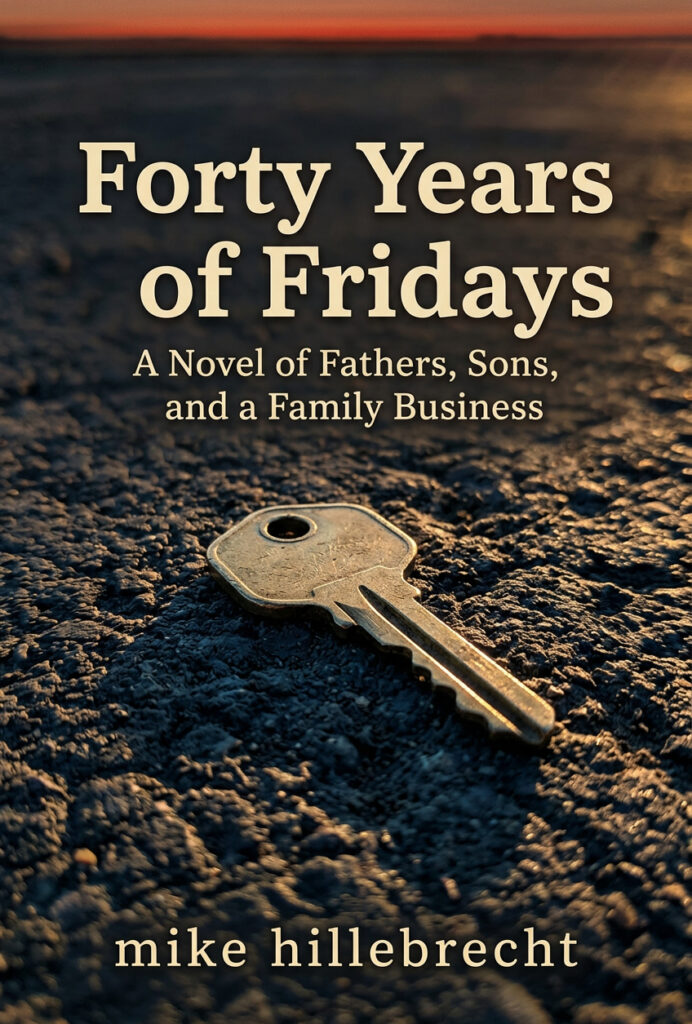
Forty Years Of Fridays
A Novel of Fathers, Sons, and a Family Business
Mike Hillebrecht
Literary Fiction
Jack Mercer has run Mercer Landscape & Development in Reno for forty years. On a Friday, his younger son Ryan posts a ten-second clip of a sunrise, and it goes viral. Over the weekend, after his wife, Ellen, who runs the company’s finances, asks what it would mean for something to be given, Jack writes a question on a scrap of paper: “Forty years — what did we build?”
His older son Pat stayed. He runs development and the crews, is divorced from Claire, and is the father of eight-year-old Sophie. Ryan has the eye and builds a content business on the side. Pat spends two hours attacking Ryan’s spreadsheet and concludes Ryan can do it. Ryan asks his parents for $50,000 against a five-year repayment schedule. Jack says yes, with conditions, and on Ryan’s last Friday tells him at the gate, “Mercer will solve Mercer.” Ryan leaves for Sacramento, and later San Jose.
Pat learns to stop solving every problem himself, and the crews learn to run without him. Maddy Rheincraft of RHM Development, whose job site adjoins his, watches how he works and offers him a director-level position with a path to equity. Jack tells him to go. In California, Ryan’s largest client, a fitness-club division, collapses into restructuring. He reposts old work, sells a lens, and draws on money set aside for taxes. Jack learns to read the rhythm of Ryan’s posts and, when he does call, does not ask what he wants to ask.
Ryan drives home to Reno in a smoking truck, not knowing he is arriving at the party for Mercer’s fortieth year. Jack runs to him in front of the whole party and says, “My son came home.” A jacket, a pair of boots from a former employee, and a house key follow. Pat, who carries a key no one needed to place in his hand, says nothing.
The last three chapters are conversations. At breakfast Jack answers Ryan as business owner, as investor, and as father. In the yard, Jack apologizes to Pat for letting responsibility become the language between them: “You were my son before you carried one damn thing for me.” Over breakfast, the brothers tell each other that the list of faults does not change “the first sentence.” They leave in different directions. “Not because they were divided. Because they had different places to go.”
Forty Days of Fridays is written for readers of family fiction who have been the son who left, the son who stayed, or the father who loved both without a plan.