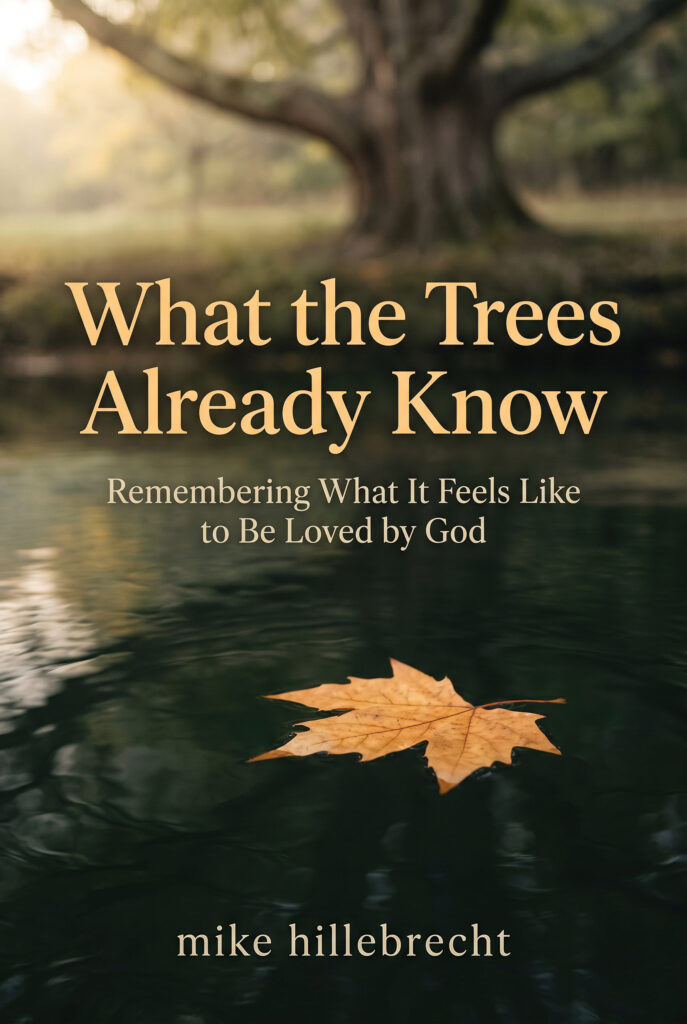
What the Trees Already Know
Remembering What It Feels Like to Be Loved by God
mike hillebrecht · Christian living / spirituality
There is nothing in this book for you to do. That is its first line and its promise. What the Trees Already Know is a short, gentle book for readers worn out by trying to earn God’s love. It offers no lessons, assignments or reflection questions. Instead, thirteen chapters each stay with one ordinary moment long enough to hear what it has been saying all along: that the reader was loved before they arrived, and has only forgotten what that love feels like.
The book moves through five seasons. In Winter, a night nurse discovers how much life begins in the dark, a newly made partner finds that the feeling he waited nineteen years for was waiting at home, and a grieving daughter learns that loss is not a verdict. In Spring, a woman’s hands remember the song that practice charts buried, adoptive parents love a child for four years before they meet him, and a man who never heard “I’m proud of you” is shown the difference between a father bent by his own storms and the Father he was named for.
In Summer, two sisters find two boxes in their mother’s attic, the same size; a boy at an archery range learns to stop counting his misses; and two brothers end forty years of keeping score. In Autumn, a farmer leaving his orchard finds next year’s buds already formed, and old pruning scars beside the best fruit. A woman learns that the holy is not only on the mountain, and a hundred-foot Douglas fir named Floyd lets a pastor feel, for a moment, that he has been found.
In Spring Again, two neighbors from rival churches share tomatoes over the fence after the same rain, a restorer uncovers a kind face beneath centuries of varnish, and the story of the father with two sons is retold with equal tenderness for both: he runs to the one who left and walks out into the dark for the one who stayed. A closing passage, “After: The Stream,” gathers the book’s characters as a leaf drifts through rocks and branches to rest in a still pool, “right where it was always going.” The book ends: “Welcome home.”
What sets it apart
The book points to the Father through nature and everyday life rather than scripture citations, while staying rooted in the Christian story. It honors grief without explaining it, separates God from the fathers who failed us, and keeps its no-homework promise to the last page. It is written for the perfectionist, the faithful rule-keeper who never felt loved, the father-wounded, the grieving, and anyone who finds God more easily under a tree than in a pew.