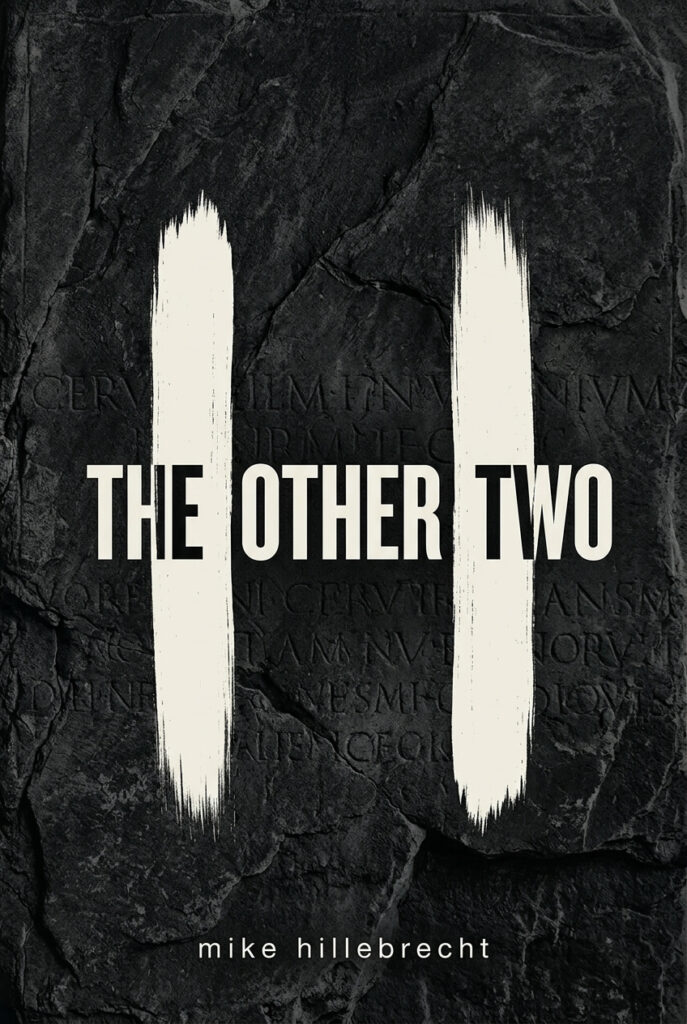
The Other Two
Mike Hillebrecht
Theological Nonfiction
Two men died on either side of Jesus at Calvary. One turned his head and asked to be remembered. He was not — not by name, not by face, not by any tradition that kept his memory the way it kept the memory of the man beside him. The Other Two begins with that silence and asks a harder question than why grace was exposed at Calvary: why did an entire tradition decide only one of these three deaths was allowed to matter?
The book’s governing claim is stated on its first page: exceptionalism is the scapegoat mechanism, run in reverse. René Girard spent a career showing how a community manufactures its peace by finding one person to expel. The Other Two names the machine’s other face — the one built out of the very discovery that should have ended it. A community can manufacture the identical peace by finding one legitimate thing to elevate instead, and quietly filing everyone else — every other tradition, every other claim, every other person who ever asked to be remembered — under let them eat cake.
From there the book walks backward. A reformer breaks the clerical monopoly on reading Scripture and watches an identical monopoly grow back, within a single generation, out of competing certainty rather than institutional authority. An emperor and a council deliver the story every reader already carries — and the book lets that story stand, uncorrected, for three full Parts, before turning and asking why a single villain and a single afternoon were always the version that felt satisfying to believe. An empire that had already named one man savior, son of a god, bringer of good news, decades before it had any reason to say those words about someone else. And underneath all of it, a Second Temple Judaism that was never waiting on one agreed Messiah at all — a household of expectation, not a queue of one, narrowed only in hindsight into the single answer everyone now assumes was always there.
Threaded through the historical argument is a second, quieter one: the average person in every one of these centuries never read the text history now holds them responsible for believing. They took the reader’s word for it — a scribe’s, a priest’s, a translator’s — the same way a reader today takes a newsletter’s or a teacher’s.
The two men from the opening page are not forgotten by the book the way they were forgotten by history. Their names, when tradition finally supplied them four centuries later, came from a text no one considers Scripture — and different regions could not even agree on what the invented names should be. Their verdicts fare no better: the man who asked to be remembered received a promise with no recorded condition attached to it, and the man who mocked received no verdict in the text at all. No accounting shown. No ledger balanced. Grace, on the book’s reading, was not choosing between them. It was holding both, before either man said a word, in a shape the merit economy was never built to recognize.
The book closes by turning back to the present and asking its opening question again, now that the reader has walked the whole excavation. It offers no new door, no correction to trade for the old one — only the claim that the ground was there before any door was ever necessary.
The Other Two is written for the reader who already senses that some version of exceptionalism survived their own deconstruction intact — relocated, not removed — and who is ready to watch the same trap that closed around two forgotten men on a hillside close around every certainty since, including, eventually, their own.