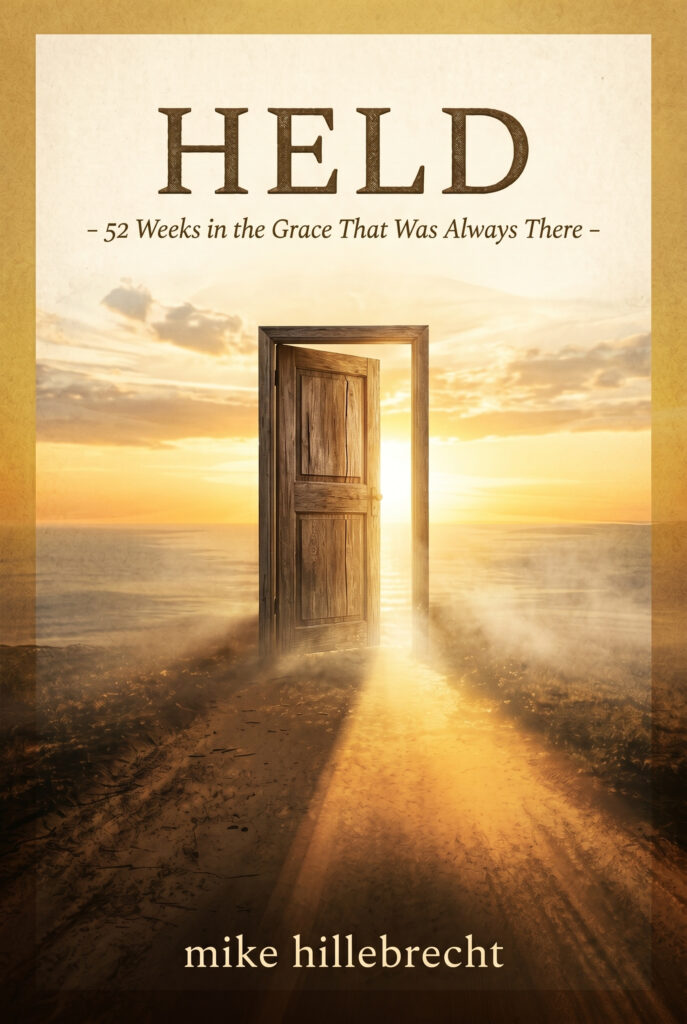
HELD
52 Weeks in the Grace That Was Always There
A Before the Beginning Devotional
mike hillebrecht
———
Most devotionals ask the reader to move toward something. HELD begins from a different premise: the grace you have been reaching for was given before the beginning of time, which means it was already present before you began to reach. The year ahead is not a journey toward grace. It is a year of slowly learning to stop blocking what was always already there.
The Claim
HELD is built on a single theological anchor drawn from 2 Timothy 1:9: this grace was given us in Christ Jesus before the beginning of time. Not before the fall. Not before the law. Before the beginning of time. Grace, in this reading, is not God’s response to the human situation. It is the original ground of creation — the prior condition on which everything else stands. The Cosmological Grace Anchor (CGA), as this framework is named throughout the study, is not a new idea. It runs through the Hebrew covenant tradition, through Paul’s revolution in the first century, through the contemplative mystics, and through every serious reader of Scripture who has ever sat with the word before and felt the ground shift beneath their feet.
The Reader
HELD is written for the reader who has done everything right and arrived somewhere they did not intend. Who has been faithful, present, and obedient — and who wakes at 3am with the specific emptiness of a person who has performed their spiritual life so thoroughly they can no longer find themselves inside it. Who has been wounded by performance-based religion and is not sure whether the wound is with God or with the system built in God’s name. Who is not looking for a new belief system but for permission to stop running long enough to find out whether there is ground beneath them.
The Format
Each of the 52 weeks follows the same six-part structure. A narrative scene drawn from one of five characters whose lives unfold across the year. A Veil Says / Spirit Says section that names, side by side, the voice of the merit economy and the voice of the grace that preceded it. An Anchor — a single scripture weighted enough to carry the week’s theme. The Word — a short cluster of passages for deeper engagement. Seven Days of contemplative practices drawn from the tradition of Christian spiritual formation: Lectio Divina, the Ignatian Examen, Breath Prayer, Written Response, Contemplative Reading, Noticing Practice, and Sabbath Rest. And a Closing Blessing — not a summary, not a takeaway, but a direct address to the reader before they return to the ordinary.
The Characters
Five characters carry the year’s narrative arc, each mapped to a parable echo from Luke 15 and arranged in deliberate sequence from the most defended to the most open. Marcus Reeves — a 42-year-old corporate vice president, the Younger Son who never left home, starving inside a life that looks from every angle like abundance. Claire Sutton — a 38-year-old school principal, the Older Son, standing outside the party she helped build, listening to music that should have been hers. Jordan Casey — a 29-year-old HVAC technician, the Lost Sheep, not rebellious but drifting, in a field that looks fine from the outside. Thomas Garrett — a 64-year-old retired surgeon, the Father, who has already been the son, survived the famine, and learned that you run first. Elene Vasquez — a 61-year-old spiritual director, also the Father, who has learned to stay in the room but has not yet fully learned to let someone stay in hers. Their stories move in parallel with the theological content across 52 weeks, carrying the formation work in narrative form for readers who arrive through story before they arrive through argument.
The Arc
The 52 weeks move through four theological territories across the year. Weeks 1 through 16 establish the ground — what grace actually is, what the three crosses reveal, how Paul’s diatribe technique in Romans dismantles the moral hierarchy the reader may have been organized around, and why the Passover framework changes what the cross is doing. Weeks 17 through 28 build the architecture — the prayer Jesus prayed, the I Am declarations, the Hebrew word chesed and its 248 appearances, the covenant love that does not recalculate. Weeks 29 through 40 name the obstacles — charis, the skandalon, mimetic desire, the scapegoat mechanism, and the grace alternative to each. Weeks 41 through 52 describe the arrival — the interior states that become visible when the false self stops performing, union consciousness, the Kingdom present tense, eternal life as zoe rather than duration, grace for shame, being not doing, and the chain of grace that was moving before the reader arrived and will continue after the book ends.
The Tradition
The seven daily practices are not invented. They are inherited from two thousand years of Christian contemplative formation — the Desert Fathers, the Ignatian Exercises, the Hesychast tradition of Eastern Orthodoxy, the Benedictine rhythm of Lectio Divina, the Celtic practice of attentiveness. An appendix at the back of the volume provides the historical roots of each practice for readers and facilitators who want to understand where the practices come from and why they have lasted. The practices are simplified for lay use but are not diluted — they carry the full weight of the traditions they draw from.
The Ecosystem
HELD is the entry point to the Before the Beginning ecosystem. A 52-session facilitator’s guide — Before the Beginning: A Study in Grace That Cannot Be Earned or Lost — is currently in development for small group leaders and spiritual directors who want to take their communities through the same theological territory in a weekly facilitated group setting. A participant workbook with daily readings is in preparation for groups who want to supplement the weekly sessions with individual formation work. A novel — Before the Beginning: The Veil — is in editorial development as companion literary fiction for readers who want to inhabit the theological argument as story. HELD is designed to stand fully alone. It does not require the other products to deliver a complete year of formation. The ecosystem exists for readers who want to go deeper.
Comparable Titles
HELD occupies the space between Richard Rohr’s Falling Upward — in its theological argument against the merit economy and its engagement with the contemplative tradition — and Barbara Brown Taylor’s Learning to Walk in the Dark — in its insistence that the ordinary is the site of the sacred and that formation happens in the specific, embodied, unglamorous conditions of actual life. It shares the structural commitment of Mark Yaconelli’s Contemplative Youth Ministry in its use of the contemplative practices as formation tools rather than techniques, and the narrative accessibility of Brennan Manning’s The Ragamuffin Gospel in its orientation toward readers who have been wounded by performance-based religion. It is longer and more structurally ambitious than any of these comparisons, but it is writing for the same reader — the one who is tired of the running and does not yet know there is ground beneath them.
———
The grace was there before you arrived. HELD is a year of learning to stop arguing against it.