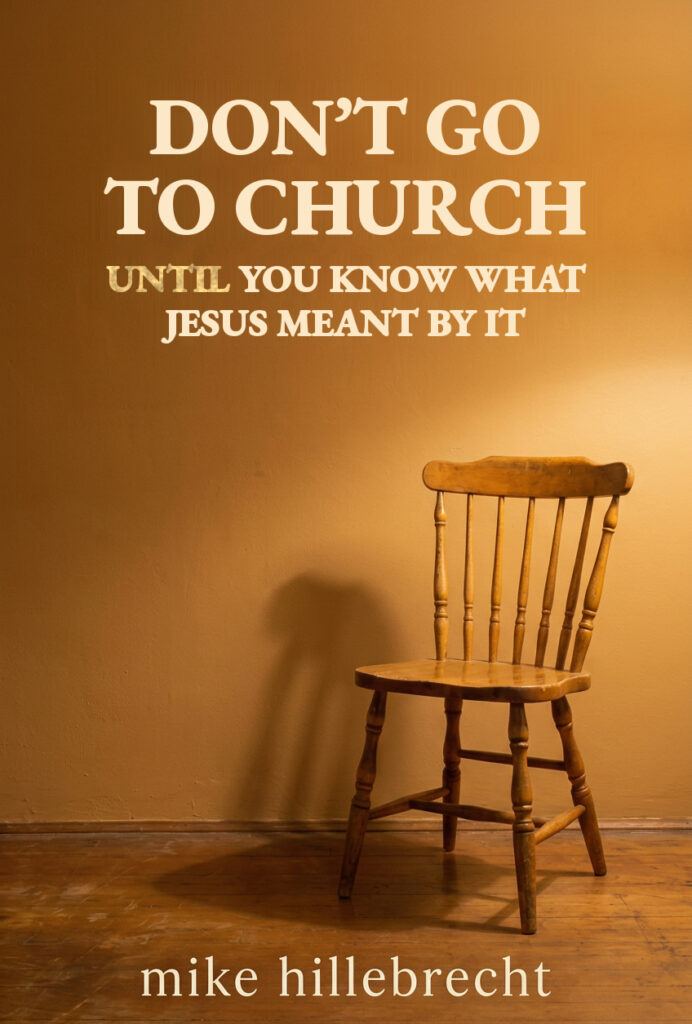
Don’t Go to Church
Until You Know What Jesus Meant by It
Mike Hillebrecht
Theological Nonfiction
“You don’t need church.” The book opens with the sentence its reader may already have said when a friend, a neighbor, or a coworker offered an invitation. It does not argue with the sentence. It asks the reader to stay with it long enough to find out what, exactly, was being declined.
Don’t Go to Church is written for the unchurched, the dechurched, and the skeptical, and it sets no belief test at the door. The author states early that he believes in God, then declines to make that belief the price of reading. Three images carry the book: an empty chair, a dinner table, and a neighbor’s porch step. The first chapters take the reader’s objections at face value, including money, the sense of “them,” and the harm done in a church’s name, and then make the book’s governing claim: God is not waiting for the reader to arrive, and God’s care precedes belief.
The middle chapters go to the Gospels and Acts: Jesus at Levi’s table, Simon and the woman, the withered hand, and Peter as rock and hindrance in Matthew 16, where Jesus says he will build his church. The house churches of Acts and Corinth show what that building looked like. From there the book asks what a gathering could be without a test at the entrance: a chair for doubt, for grief (“Because Life Is Heavy”), for joy, for service (“Love With Its Sleeves Rolled Up”), for difference and politics, and for Jesus without the sales pitch.
Chapters 17 and 18 imagine such a gathering and then build one, taking up the second meal, authority, money, children, privacy, and what is done when harm occurs. Chapter 19, “No Insiders, No Outsiders,” names the ground under all of it: cosmological grace, drawn from 2 Timothy 1:9–10 and Ephesians 1:3–5. The cross revealed God’s love rather than creating it, and boundaries concern conduct, not worth.
The last three chapters, “Why Would You Come?”, “If You Decide to Go,” and “You Still Don’t Have to Come,” answer the invitation honestly in both directions. The book ends where it began: “You still don’t have to come. But there’s a chair if you want it.”
Don’t Go to Church is written for the reader who has left church, or never entered, and wants an honest account of what Jesus meant by it before deciding anything.