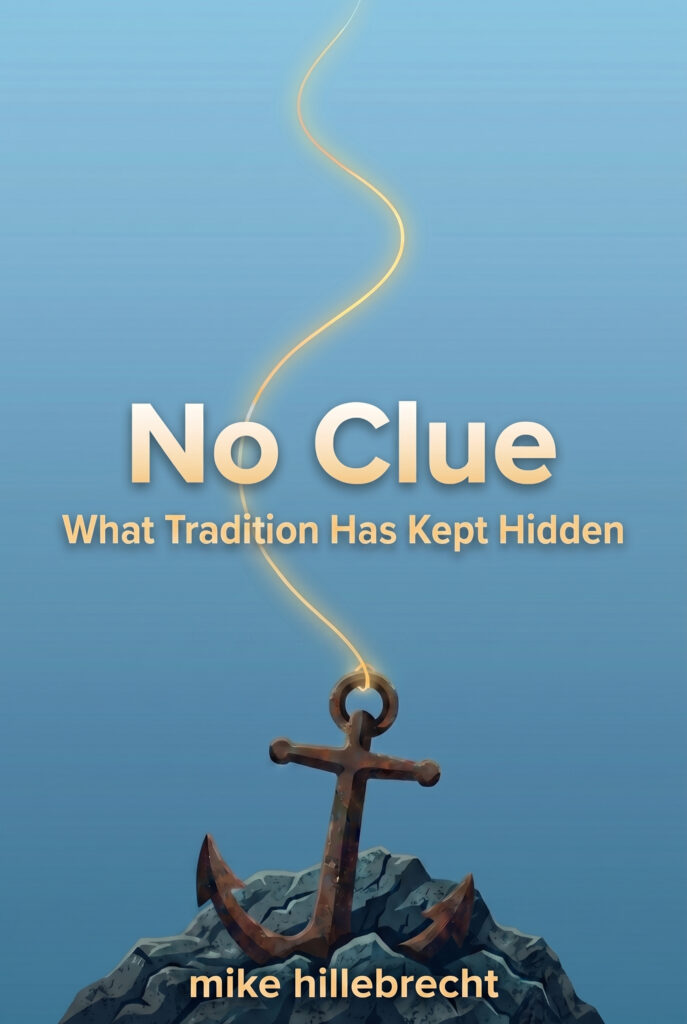
No Clue
What Traditions Have Kept Covered
Mike Hillebrecht
Most people raised in church were handed a smaller version of grace than the one actually in the text. Not a false version — a compressed one. A grace that rewards consistency, requires maintenance, and quietly implies that God’s love tracks with your performance. The result is a specific kind of exhaustion: not the exhaustion of hard work, but the exhaustion of perpetual calibration. No Clue is a systematic dismantling of that system, built on the original languages that institutional religion has been quietly compressing for centuries.
The book begins with a single Hebrew word: chesed. It appears 248 times in the Hebrew Scriptures, clusters around moments of greatest human failure, and has been routinely under-translated as “steadfast love” or “lovingkindness” — words that give the outline of the painting without the color. Chesed is not a quality love sometimes has. It is the name for what God is. Not what God decides to give. What God cannot stop being.
From that foundation the book follows the word into the Greek world — through the Septuagint translators who chose charis to carry what chesed was carrying, into Paul’s letters where charis appears a hundred times with surgical deliberateness, and outward through the implications of that word for identity, union, lostness, suffering, and the cross itself. Each chapter removes a layer of institutional distortion: the merit economy that masquerades as theology, the paidagogos misread as destination rather than escort, the poiema of Ephesians 2:10 that repositions good works from the cause of belonging to the natural outflow of it, the lostness of Luke 15 that is perceptual rather than ontological, the cross that did not introduce grace into a graceless world but exposed the grace the world was always made of.
The organizing claim — the Cosmological Grace Anchor — runs beneath every chapter: grace is not God’s response to human failure. It is the ontological ground of creation itself. Calvary shows what Genesis established.
The book closes not with a call to try harder but with an invitation to stop. To let the performance scaffolding come down and discover that what was underneath it was not, as the merit economy always feared, nothing — but the ground of belonging that was never behind a gate in the first place.
You cannot earn what was never withheld.