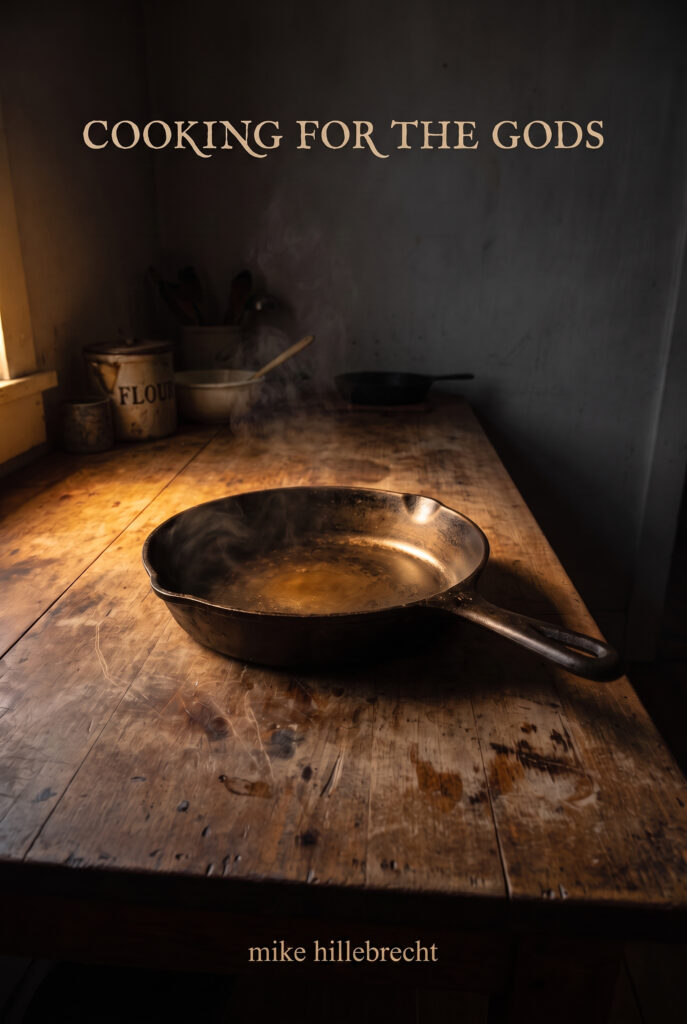
Cooking for the Gods
by Mike Hillebrecht
Cooking for the Gods opens with a confession: the author’s clearest childhood memory of grace wasn’t in a pew, but at his grandfather’s Weber grill, where salt, cracked pepper, and two hours of patient smoke taught him — long before he had any theology for it — that a meal could hold more than food. That memory sets the terms for everything that follows: grace is not a reward a good meal earns. It’s the ground a person is already standing on before the stove is even lit.
The book unfolds as a single day, guided by an unnamed waiter who moves through each hour noticing what the reader needs before they ask for it. Four movements — Morning, Midday, Afternoon, and Night Watch — each pair a short essay, a devotional meditation, and a full recipe, building the case that no meal, however ordinary, sits outside the reach of the sacred.
Morning Light opens at the pantry door, arguing that the first decision of the day — what to eat, and whether to pay attention while doing it — is already a spiritual practice. It moves through inherited recipes and family memory, framing the food handed down to us as a living archive of the people who made us.
Midday confronts the drive-through line without condemning it, asking what’s actually being fed when convenience wins. From there it turns outward, into meals shared with others: the chapter argues for abundance over surplus — giving from a posture of trust rather than waiting for leftovers — and shows how the briefest shared meal can dissolve real differences between strangers, if only for the length of a plate.
Afternoon treats the transition hour — the cocktail hour, the pause between labor and evening — as a threshold the reader is invited to notice rather than rush through. It builds to the book’s clearest picture of hospitality: a meal prepared for a specific, named guest, treated as a sacred appointment rather than an obligation.
Night Watch closes the day at the table understood as altar, then follows the reader all the way to the last bite before sleep — the midnight snack — arguing that grace doesn’t keep business hours. Indulgence and restraint are reframed not as a moral battle but as two forms of honesty about what the body actually needs.
The book closes with “The Table You Are Called to Set,” restating its whole claim in plain terms: nothing here was ever asking the reader to earn their way toward the divine through better cooking. The grace was already present before the first onion was diced. Every chapter was simply an invitation to notice it. The final image — “Come to the table. The meal is ready” — hands the entire argument back to the reader as an open door rather than a conclusion.
Structurally accessible and theologically load-bearing at once, Cooking for the Gods functions as the most approachable entry point into Hillebrecht’s larger Cosmological Grace Anchor framework — the same argument found in his denser theological studies, made here in a kitchen instead of a classroom.